


“The services provided by Pet Dental Services have proven to be invaluable to our practice. Our clients appreciate the safety and convenience that non-anesthetic dentistry provides to their pets. Pet Dental Service’s staff is incredibly kind and patient with the pets in their care. Even some of our fearful patients are able to benefit from a full dental cleaning due to the gentle care provided by the PDS staff.”
-
 Dr. Melissa Byers
Lake Forest Animal Clinic
Lake Forest, CA
Dr. Melissa Byers
Lake Forest Animal Clinic
Lake Forest, CA
-
“Their technique is gentle yet so very effective in the patients that qualify for this procedure. I have not encountered a case yet that I am not totally satisfied with the outcome. Having Pet Dental Services as part of your healthcare team is a win, win, win situation.”
Dr. Laurie Koorhan
Doctors Pet Clinic
Murrieta, CA
-
We have been very happy with the level of service we receive from Pet Dental Services, a teeth cleaning service without anesthesia for cats and dogs. They are very professional and relaiable. They are friendly and knowledgeable regarding dental cleaning, and are very good with our clients. They take the time to explain the procedure and are always willing to over the dental report with the client.
Their technicians arrive once per week (4 times per month) to our clinic, bringing with them all their own equipment. they perform a full teeth cleaning with manual polishing and complete charting, which the client gets a copy of. They typically service between 80 and 100 patients per month at our facility.
The level of professional care can be seen by us as well as the clients, which keeps most of them booking repeat cleanings for their pets on a regular basis.
We would be more than happy to recommend Pet Dental Services to any veterinary clinic or animal care facility.
Eric Christensen
Hospital Administrator
Founders Veterinary Clinic
-
“Since day one working with the Pet Dental Services crew, we have been impressed with their ease handling our numerous film animals, and the undeniable fact that our dental costs have reduced significantly.”
Birds & Animals Unlimited are the owners and trainers of numerous film animals including Moose from “Frasier”, Laiko from “Because of Winn Dixie”, Pongo & Perdy from “101 & 102 Dalmatians”, Coal from “The Shaggy Dog”, just to name a few.
Lorraine Putnam
Operations Manager
Birds & Animals Unlimited
-
I have been using the non anesthetic dental cleaning treatments for approximately seven years now and they work great. They are in no way intended to take the place of deep cleaning, extractions and radiographs that are all done during anesthetic dentals. They are an excellent complement to thorough dental care. Once a deep cleaning is done with anesthesia, a follow up preventative cleaning is scheduled in 4 to 6 months to maintain the teeth in great health. Younger dogs with no major dental disease can be scheduled for non anesthetic dentals to prevent the tartar buildup and gingivitis. They are to be used as we do with people, routine dental cleanings to prevent severe dental disease. The non anesthetic dentals if started early in the life of our pets, followed up with good home care can prevent a lot of problems in the future. They are also a great alternative for the geriatric pet that has a greater risk with anesthesia. The advantage with the geriatric pet is greater if dental cleaning has already been instituted in the past when the pet was in good health.
Dr. Cristina Comartin
-
“I was very happy with the cleaning that the technician did.”
Ethel Levine
-
“The technician was absolutely fantastic at educating me on my pet’s dental health.”
C.L.
-
“I would definitely recommend Pet Dental Service to my family and friends.”
Michelle O’Keefe
-
“The PDS technician thoroughly explained my pet’s dental health needs.”
S.J.
-
“The technician was thorough, kind and clearly she loves the animals with whom she works.”
Erica Simba
-
“If Pet Dental Services was a hotel, I would give you 5 stars.”
Erica Melville
-
“I would absolutely recommend Pet Dental Services to my friends and family.”
S.J.
-
“The technician was fantastic, very educated and all around it was a great experience.”
Jenny McKell
-
“The technician had great communication over the phone.”
Jeanette Orlen
-
“I was educated on my pet’s dental health needs by the technician, and I would recommend Pet Dental Services to my friends and family.”
P.P.
-
“I feel this service really keeps my pet’s breath fresh”
Cheryl Rice
-
“The technician was excellent! She explained everything and kept me updated.”
Ann Marie Gamble
-
“The technician gave very helpful tips on the techniques for brushing our dog’s teeth. I was amazed that he wagged his tail through the whole cleaning!”
Shirley McCray
-
“The technician was very thorough in her communication.”
Barbara Elliot
-
“The technician was very educational and I am very happy.”
H.Z.
-
“I have seen what dental neglect can do, and this procedure is very beneficial.”
B.F.
-
“Better health and a happy babygirl make this service so beneficial.”
J.S.
-
“I love the result of the cleaning, the friendly technicians and that my dog is not frightened.”
Colleen Dickson
-
“Without this service, my dog would be in serious trouble with bacterial infections.”
Sylvia Crockett
-
“The technician was very gentle with my Dachshund and explained the at home cleaning process thoroughly.”
John James
-
“I love that I don’t have to sedate my dog! Her appointment was right on time and the technician was very kind and honest.”
Jessica Lawson
-
“I have a fussy dog who doesn’t like her mouth touched and the PDS technician was able to successfully and thoroughly clean her teeth.”
Christie Lesinski
-
“The researchers were able to identify all areas of pathology, and confirmed their findings with radiography. Therefore, their research supports the conclusion that a probing and cleaning can be done without general anesthesia.”
Patrick Hardigan Ph. D.
-
“I have been using Pet Dental Services for the past 3 years. Not only is the staff courteous and professional, but the extent of the work being done is superlative. Since we have started offering this lower cost non-anesthetic option, client compliance has begun to improve. It is a win/win situation, pets that are eligible for this non-anesthetic procedure are getting the dental care that is essential for their overall health and clients are benefiting from getting affordable preventative care. Also, some clients are extremely sensitive to placing their pet under anesthesia. It is a pleasure being able to satisfy the clients, but also give the pet the care they deserve.”
Brian Gerard, D.V.M.
-
“The technician is always helpful, professional and on time.”
Terry Archer
-
“If I hadn’t had the dental scheduled with Pet Dental Services, I don’t think the nasal growth would have been found.”
F.L.
 (866) 561-6717
News & Updates
All News & Updates



News & Updates
Enter your email below to receive coupons, the latest PDS news, and tips and tricks for caring for your pet's teeth.
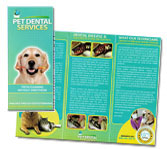
Download Brochure (PDF)
Show this brochure
to your vet and
request our service
in your hospital.
Home Dental Care
Brushing your pet’s teeth can go along way toward preventing dental disease. Some pets resist brushing, but most eventually accept it, especially if you start a brushing routine when your pet is young (10 weeks to 10 months). Aim at brushing your pet’s teeth once a day or at least 3 times a week.
Step 1: Choose a pet tooth paste your pet likes (don’t use human tooth paste or tooth brushes on your pet. Human toothpaste may be toxic in pets if ingested, and human toothbrushes are too big usually for their mouths). Place a small amount of toothpaste on your finger, and offer it to your pet daily for several days as a reward or treat. This will condition your pet to view brushing as fun and rewarding. Once your pet accepts toothpaste as a reward, use your index finger to stimulate the brushing motion of a toothbrush, while praising the pet and giving the daily dose of flavored toothpaste.
Step 2: In five to seven days, introduce a soft bristled pet toothbrush. You can apply a small bit of the flavored toothpaste at the beginning and end to reinforce the conditioned behavior, position the brush at a 45-degree angle to the tooth. Make small circular motions beginning at the back of the pet’s teeth moving forward and around to the otherside. Eight to ten strokes are sufficient for any given area.